
The XK Engine
The twin-cam six
The Jaguar E-Type engine is the XK twin overhead camshaft six. Why that mattered in a production road car in 1948, what changed when the 3.8 became the 4.2, and what the engine asks of you as an owner.
Why it mattered
The XK engine was designed at Jaguar during and just after the war, with William Heynes, Walter Hassan and Harry Weslake the names usually attached to it, and it went into production in the XK120 in 1948. The significant thing was not its capacity but its architecture. Twin overhead camshafts and hemispherical combustion chambers in an aluminium cylinder head were racing practice at the time, found on competition engines and on a handful of exotic road cars. Jaguar put that layout into a car it intended to sell in volume, and then kept the engine in production, in one form or another, into the 1990s. Very few engine designs have had that kind of working life.
By the time the E-Type appeared in 1961 the engine already had Le Mans wins behind it in the C-Type and D-Type. The E-Type inherited a thoroughly developed unit rather than a new one, which is a large part of why an early car was as usable as it was.
This page covers the six-cylinder cars only. Series 3 used an entirely different engine, the 5.3-litre V12, which has a page of its own: the V12 engine.
The 3.8
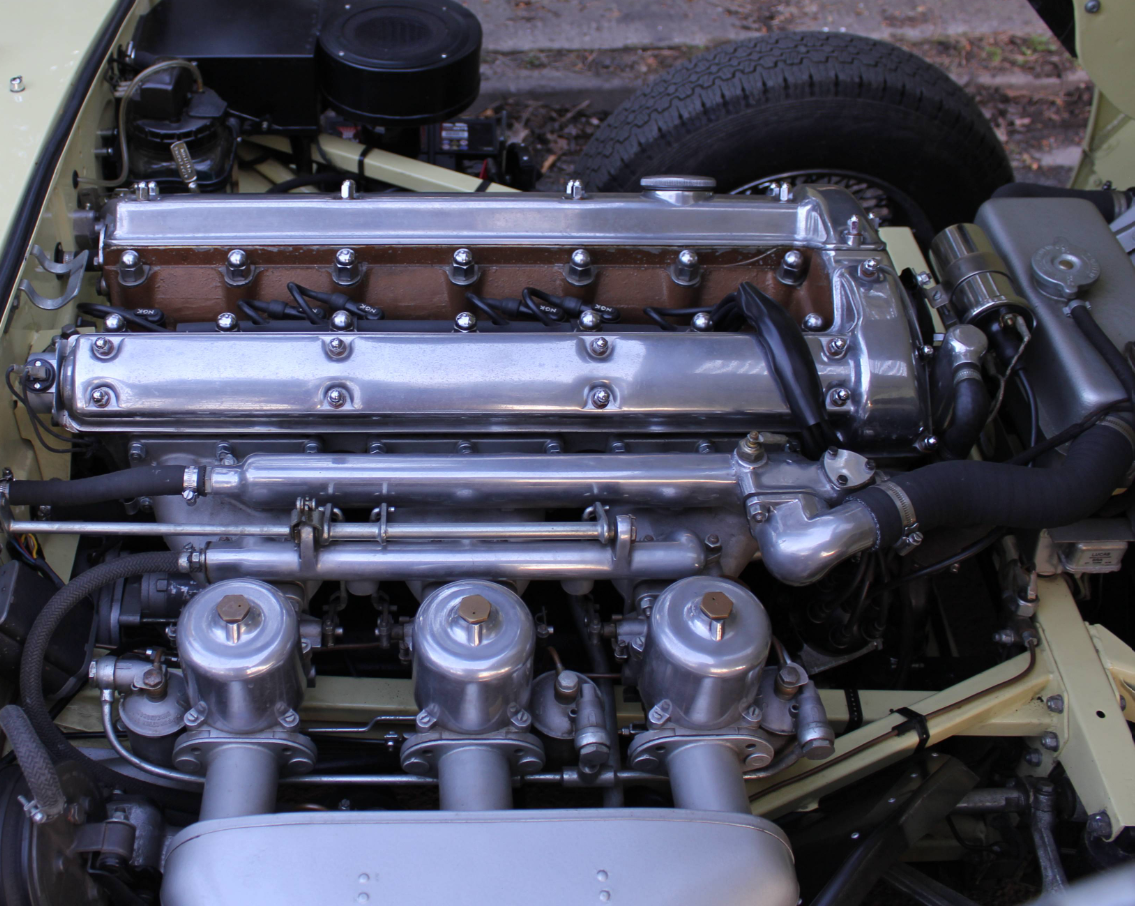
The Series 1 3.8 uses the 3,781 cc version of the XK six, with a bore of 87 mm and a stroke of 106 mm. In E-Type form it ran the straight-port cylinder head, commonly called the wide-angle or straight-port head, with three SU HD8 carburettors on cars for markets without emissions requirements.
The output usually quoted is 265 bhp. That figure needs a caution attached to it every time it is used. It is a gross figure, measured to the practice of the day with the engine on a bench and without the ancillaries, air cleaner and exhaust system it would carry in the car. It is not comparable with modern net figures, or with the SAE net figures used in the United States from the early 1970s. The number is genuine as a historical quotation and misleading as a comparison, and the specifications page sets out which standard each published E-Type figure was measured to.
The 4.2
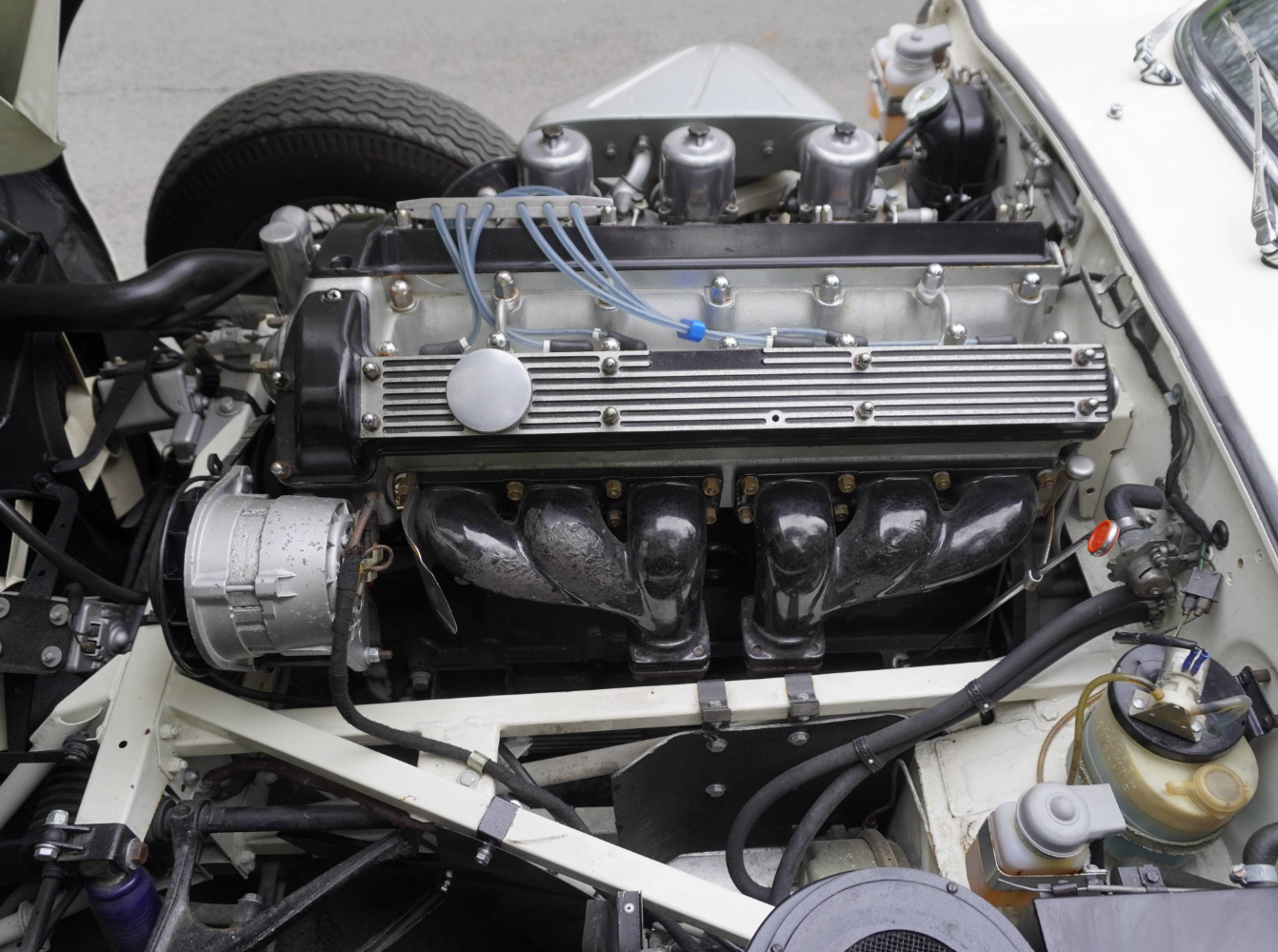
In the second half of 1964 the engine grew to 4,235 cc. The stroke stayed at 106 mm and the bore went out to roughly 92 mm, which meant a new block with the cylinder bores re-spaced to fit. The head, valve sizes and camshafts were substantially carried over.
The quoted power was unchanged at 265 bhp gross, and Jaguar did not claim otherwise. The gain was in torque and in the way the engine delivered it lower down, which made the car easier to drive without working it. The other improvements arriving alongside it, the all-synchromesh gearbox, a better brake servo and a revised electrical system, did as much for the car as the extra capacity.
Whether a 3.8 or a 4.2 is the better car is an argument with no answer. The 3.8 is usually described as the sharper-sounding engine and the 4.2 as the more tractable one, and the gearbox is the more consequential difference for most drivers.
Carburettors
Series 1 cars for the home market and most of the world ran three SU HD8 carburettors. From the 1968 model year, cars built to United States specification, meaning the interim cars often called Series 1.5 and then Series 2, ran twin Zenith-Stromberg carburettors with air injection, to meet the first American emissions regulations. Cars for other markets kept the three SUs through Series 2.
The twin-Stromberg cars are generally reckoned to have lost power against the triple SU installation, and a figure of 246 bhp gross is cited for them. Owners of these cars frequently convert to a triple SU setup, which is a well-understood job with a supply of parts behind it, though it has implications wherever emissions equipment is part of a car's legal or historic specification. The carburettors are also one of the fastest ways to date a car, as set out on the series identification page.
Living with it
The XK is a long-lived engine that repays maintenance and punishes neglect in fairly predictable ways. Some general observations, none of which substitute for a workshop manual:
- Cooling. Series 1 cars in particular are known for running hot in traffic. The radiator, the fan, the header tank system and the general condition of the waterways all matter. Jaguar's own response was the larger air intake and twin fans of Series 2, which tells you the factory considered it a real problem rather than an owner myth.
- Valve clearances. The engine uses bucket tappets with shims. Adjusting clearances means removing the camshafts, so it is a proper job rather than a roadside one, and it tends to be neglected as a result.
- Timing chains. Duplex chains in two stages, with a tensioner that wears. Chain rattle is a known warning, and access to the upper chain is reasonable while the lower one is a much bigger undertaking.
- Oil pressure and oil leaks. Low pressure when hot points at bearing wear. A degree of seepage is normal on a design of this age, and a car that has never leaked has usually been apart recently.
- Carburettor balance. Three SUs need to be set up together. Poor running on an XK is more often fuelling or ignition than anything internal.
One further point that matters when buying or documenting a car. Engine numbers on the XK are stamped on the block and on the head, and a matching-numbers claim can be confirmed against the original records. Use xkedata.com to see what is recorded for a given chassis and engine number, and order a Heritage Certificate from the Jaguar Daimler Heritage Trust for the authoritative record of what a particular car left the factory with.
Common questions
What engine did the Jaguar E-Type have?
The twin-cam XK straight six, of 3,781 cc in the first cars and 4,235 cc from the second half of 1964, and then the 5.3-litre V12 from Series 3. All of them drive through the front-mounted engine and a four-speed gearbox, with automatic transmission offered on 2+2 and Series 3 cars.
How many cylinders does an E-Type have?
Six on Series 1, Series 1.5 and Series 2, arranged in line. Twelve on Series 3, in a 60 degree vee. There was no four-cylinder or eight-cylinder E-Type.
Did the E-Type have an aluminium cylinder head?
Yes. The XK six used an aluminium twin-overhead-camshaft head with hemispherical combustion chambers, a layout drawn from racing practice and unusual on a volume-production road car when the engine was designed in the 1940s.
How much power does the E-Type engine produce?
Jaguar quoted 265 bhp for both the 3.8 and the 4.2, and 246 bhp is cited for the twin Zenith-Stromberg cars built to United States specification. These are gross figures measured to the practice of the day and are not comparable with modern net ratings.
What carburettors does an E-Type use?
Three SU HD8 carburettors on Series 1 cars for the home market and most export markets, and on Series 2 cars outside the United States. From the 1968 model year, cars built to United States specification, meaning the interim cars often called Series 1.5 and then Series 2, ran twin Zenith-Stromberg carburettors with air injection to meet the first American emissions rules.
What is the difference between the 3.8 and the 4.2 engine?
Capacity, through a larger bore on a new block with re-spaced cylinders, and the torque that came with it. Quoted power was unchanged. The changes arriving alongside the 4.2, principally the all-synchromesh gearbox and the better brake servo, matter as much to a driver as the engine itself.